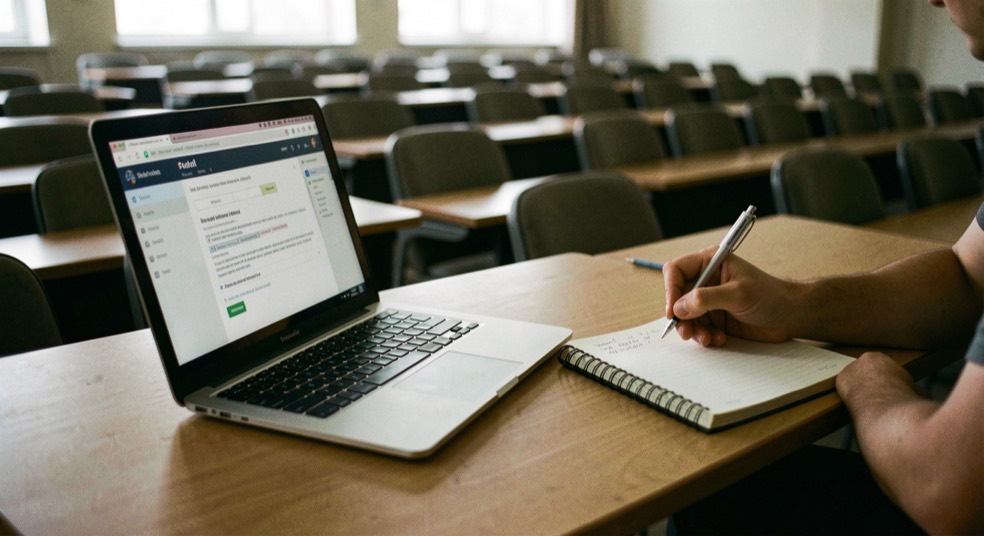
Both tools on the same desk, which is how most people actually work once the novelty of choosing has worn off.
The argument gets moralised quickly. Paper is treated as serious and screens as a distraction, and the real question disappears underneath. The real question is narrow and answerable: in a two hour lecture, which tool leaves you with a page you will still use in eight weeks?
Start with what each tool does mechanically. A competent typist runs at somewhere between forty and seventy words a minute. Handwriting runs at roughly twenty. A lecturer speaks at around a hundred and thirty. Neither tool keeps up, but the keyboard comes close enough that you can attempt a transcript, and the pen never lets you try. That gap is the whole story.
Typing keeps up, and that is the problem
When you can nearly keep up, you stop choosing. The notes become a stream, and the stream is produced without passing through comprehension: the ear hears a phrase, the fingers reproduce it, and nothing in between is required to understand it. You leave with four thousand words that look like a full record and are, in practice, a recording you cannot search by meaning.
The consequence shows up when the notes are reopened. Verbatim files are long, undifferentiated and exhausting to revise from, so they get read rather than worked, and reading is the weakest study activity available. It also produces the familiar illusion of competence, where the material feels known because it is familiar on the page.
Typing does have genuine advantages, and they are not small. Text is searchable across a whole term. It can be reorganised after the fact without recopying. It is legible in April, which handwriting sometimes is not. For anyone whose handwriting is slow or painful, it is not a preference but the only workable option, and no method is worth a wrist injury.
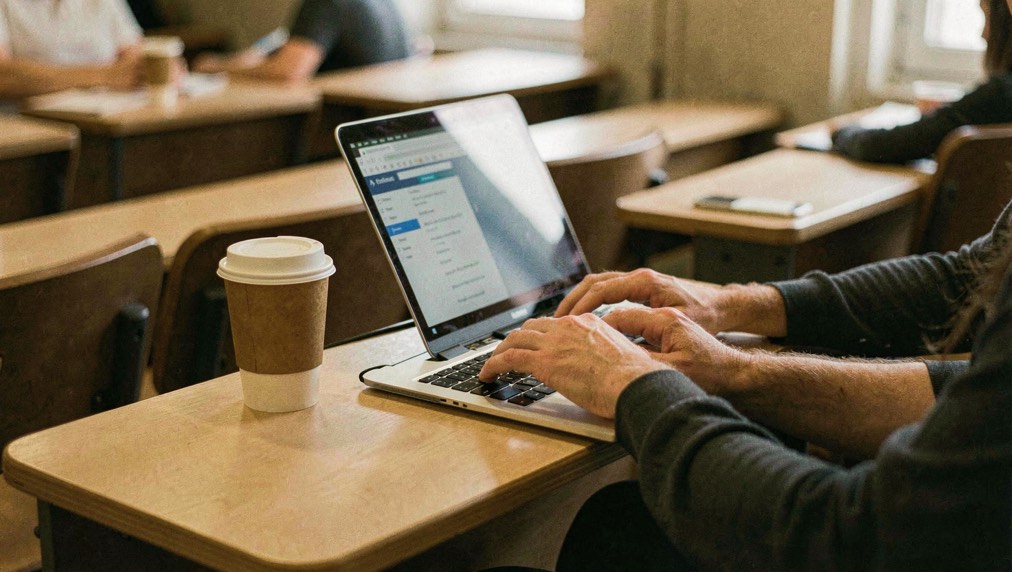
A keyboard at typing speed produces a stream, which is why the selection has to be imposed by a rule rather than by the pace of the room.
The pen forces a decision on every line
Because handwriting cannot keep up, every sentence is a choice about what matters, and the choice is made while the explanation is still live. That compression is the mechanism. You hear a three minute explanation of why a market fails, and you have time for one line, so you have to decide what the three minutes were for. Doing that thirty times in a lecture is a rehearsal of the material rather than a record of it.
Handwriting also allows things a text document resists: an arrow across the page, a bracket linking two ideas, a diagram sketched in four seconds, a question mark in the margin. A page can be laid out spatially in a way that a linear file cannot, which is why the two column arrangement described in the Cornell page, six months later works on paper and feels artificial on a screen.
The cost is real. Twenty words a minute means gaps. If the lecturer is fast, does not publish slides and is the only source for the material, gaps are expensive, and a pen can leave you reconstructing a lecture from a friend's notes for an hour.
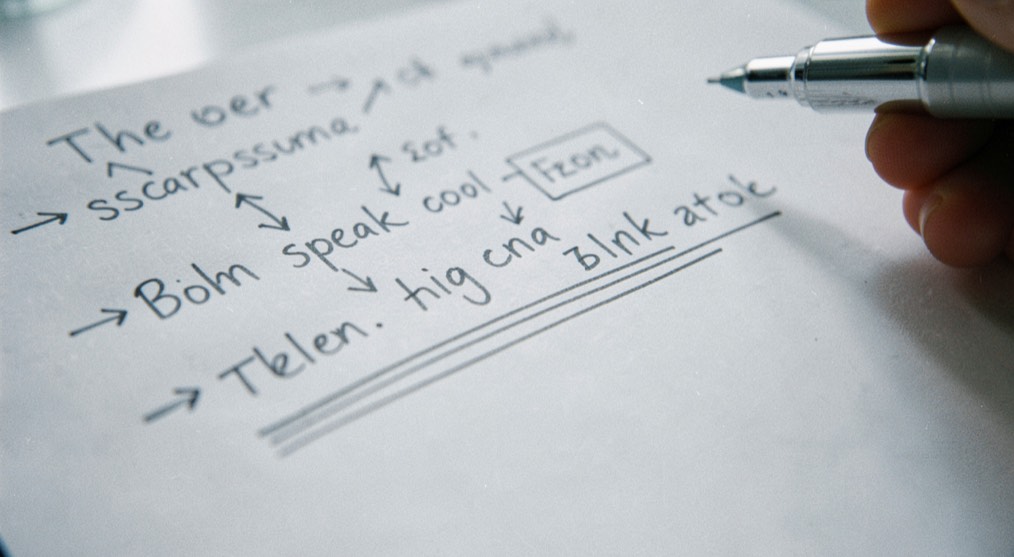
Arrows, boxes and abbreviations in the middle of a page written at speaking pace.
Choosing by what the lecture is made of
The useful question is not which tool is better but what the hour contains. Lectures that arrive as argument, narrative or interpretation reward the pen, because the value lies in the structure and the structure is what compression captures. Lectures that arrive as dense factual coverage, long code listings or worked numerical procedures reward the keyboard, because losing a step loses the whole thing.
Whether the slides are published matters more than either tool. When a full deck goes up afterwards, the notes only need to carry what is not on the deck: the asides, the worked examples, the emphasis. That is a job for a pen and half a page. When nothing is published and the reading list is thin, the lecture is the primary source and completeness earns its keep.
When the notes are for a workplace skill rather than a course, the spreadsheet macros in why VBA still shows up in interviews are a good example of learning just enough of a tool.
Decide once per module, in the second week, and write the decision at the front of the file:
- Slides published and material argumentative: pen, half a page per hour, questions in the margin.
- Nothing published, dense factual or procedural content: keyboard, then cut the file down the same evening.
- Whichever tool you choose, the notes are not finished until something has been done to them within the day.
That last line is where both tools succeed or fail together, and it is the limit of this whole comparison. A typed file cut to a third of its length and turned into questions beats a handwritten page that was never reopened. The tool decides how much processing the notes will need, not whether they need it, and why that processing has to be conversion rather than tidying is the argument in rewriting notes is not revision. If the evening pass is the part you keep skipping, the cheapest fix is the exercise in the one page summary, built while the lecture is fresh, which takes fifteen minutes and produces something you can revise from directly.
One caution about the middle path. Taking a laptop for slides and a notebook for thinking works, but only if the laptop is closed for the parts you intend to think about. Two open channels usually means the notebook stays empty, and by the second month you have quietly become a typist who also carries a notebook.