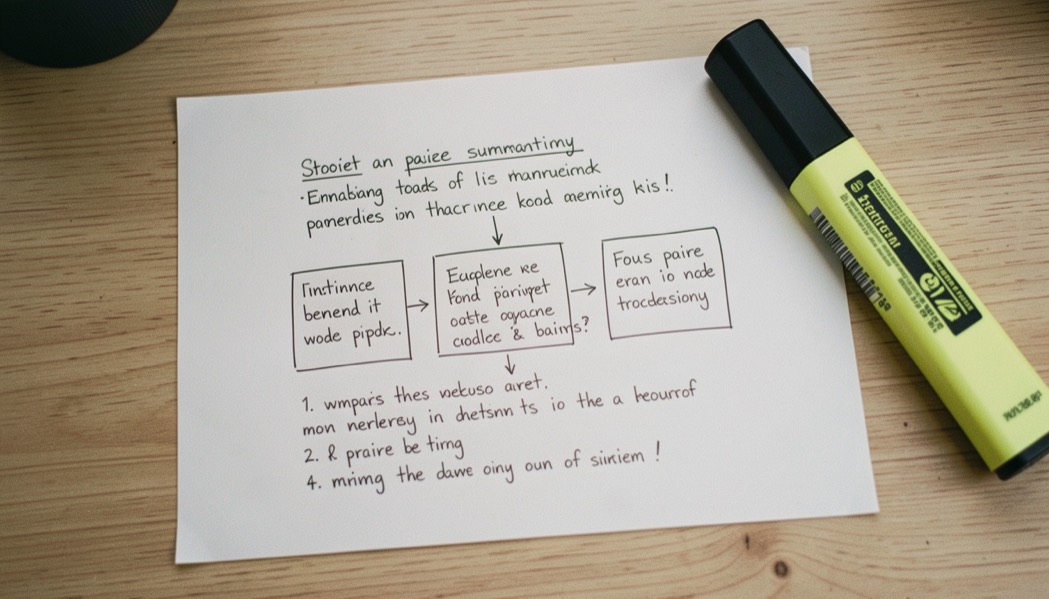
A finished sheet for one topic, with the three main claims boxed and the links between them drawn in.
The constraint is the method. One topic, one side of A4, nothing else. Everything that matters has to fit, which means deciding what matters, which is the part of revision that most study techniques quietly skip. The sheet is not a summary in the sense of a shorter copy. It is a reconstruction, written with the notes shut.
Timing matters as much as format. Built in the week the topic was taught, the sheet costs about half an hour and catches gaps while there is still a lecturer to ask. Built in the revision period, it costs the same half hour but the gaps it exposes now have to be repaired under time pressure.
How the sheet gets made
Sit down with a blank sheet, a pen, and everything else out of reach. Set a timer for twenty five minutes. Write the topic at the top, then reconstruct it: the main claims, the mechanism or argument behind each, the worked example that makes it concrete, the standard objection, the thing the lecturer said was commonly got wrong. Draw arrows where two parts connect. Leave gaps where you cannot remember and mark them with a dash so you can find them later.
Then stop, open the notes, and correct in a different colour. Do not rewrite the sheet. The corrections stay visible, and the coloured additions are the most valuable marks on the page, because they are precisely the material that did not survive without support. That is your revision list for the topic, generated by evidence rather than by feeling.

The start of a sheet: paper, timer, and the source notes closed and turned face down.
What goes on the sheet and what stays off
Things that belong: the claim, the reason, the example, the exception, the connection to the neighbouring topic. Things that do not: definitions that are one dictionary lookup away, the lecturer's introductory joke, any sentence you have copied without changing. If a line could have been written by someone who had not attended, it is padding, and padding is expensive on a page this size.
Handwriting size is a useful signal. If the writing has to shrink to fit, the topic has probably been split wrongly, and two sheets are needed. If a third of the page is still empty after correction, either the topic is genuinely small or you have missed a section of the course; check the syllabus rather than assuming the first.
Diagrams count and are worth their space. A drawn process, a labelled axis or a three box flow will carry more of an explanation than a paragraph, and reproducing it in an exam is faster than describing it.
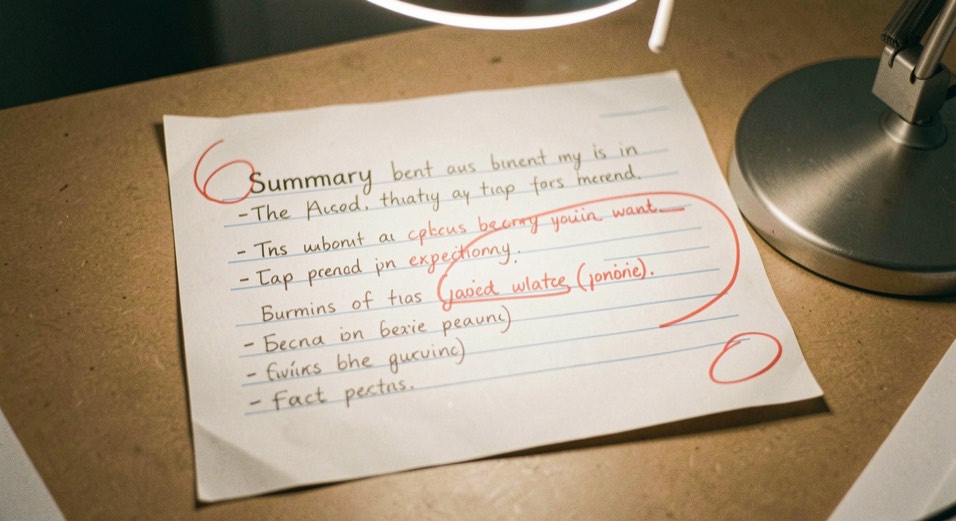
The same sheet after correction, with the material that did not come back from memory added in red.
Using the sheets later
A stack of sheets is a syllabus in physical form, and it can be used in three ways. It can be read, which is the weakest use. It can be redone, which means writing a fresh sheet from memory and comparing it against the old one, and which is the strongest. Or it can be mined, which means turning each red correction into a question or a card so it enters a review schedule rather than sitting on a page.
The redoing is the part that pays. A second sheet written six weeks after the first takes twenty minutes and shows you exactly what has held and what has drained away, which is far more informative than rereading. Spacing those attempts out sensibly is covered in spaced repetition without an app, and the corrections themselves make excellent card fronts if you follow flashcards that ask harder questions.
A sheet is finished when it satisfies all of these:
- It was written with the notes closed, in one timed sitting.
- The corrections are in a second colour and were not rewritten away.
- It fits on one side, with the main claims boxed and their links drawn.
- Every gap you could not fill has become a question somewhere else.
The limit is what the sheet cannot hold. Topics built from long procedures rather than arguments do not compress: a synthesis with fourteen steps, a statistical test with a full worked calculation, a legal test with six limbs each carrying its own case law. Squeezing those onto one side produces a page of cues that looks reassuring and cannot be used to practise the actual skill, which is executing the procedure. For that material the sheet is the index and the practice is a worked example done from scratch, timed, in the manner described in past papers, timed and marked honestly.
The second limit is arithmetic. Most modules have between eight and twelve topics, and a full course of five modules is therefore fifty sheets or so at half an hour each. Spread across teaching weeks that is one sitting a week and entirely manageable. Attempted in the fortnight before exams it is twenty five hours you do not have, which is why the sentence at the top of this page is about when the sheet is built and not about how it looks.