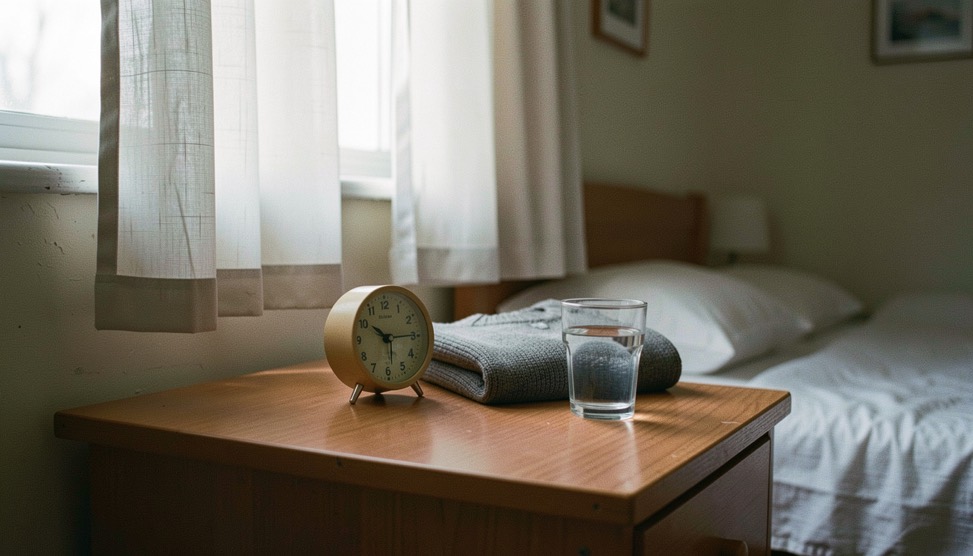
A bedside table at the hour the alarm goes off, with the curtain already open a hand's width.
The nine o'clock lecture has a reputation it does not deserve. It is not unusually early by the standards of almost any job, and the difficulty it causes is not really about the hour. It is about the previous evening, which in term time drifts later week by week without anyone deciding that it should.
The drift is physiological as well as social. Body clocks run slightly long, and they run later than average in the late teens and early twenties, which is precisely the population being asked to sit down and think at nine. Left alone with no fixed anchors, a sleep window slides forward by fifteen or twenty minutes a week, and by November a midnight bedtime has become two in the morning.
What short nights actually cost
The cost is not simply tiredness, which people learn to tolerate and then stop noticing. Short sleep degrades exactly the functions a degree runs on: sustained attention through a two hour session, working memory while holding several steps of an argument, and the consolidation that happens overnight and turns the day's work into something retrievable a week later.
That last point matters more than it is usually given credit for. A revision session followed by four hours of sleep is a much weaker investment than the same session followed by seven, because part of the learning happens after the session ends. Cutting sleep to add revision hours is, past a certain point, a trade of quality for quantity in the wrong direction.
Self assessment is also unreliable here. People who are chronically short of sleep tend to rate their own performance as normal while measurably performing worse, which is why the habit is so stable. The evidence you notice is that lectures feel harder and reading takes longer, and both get attributed to the material.
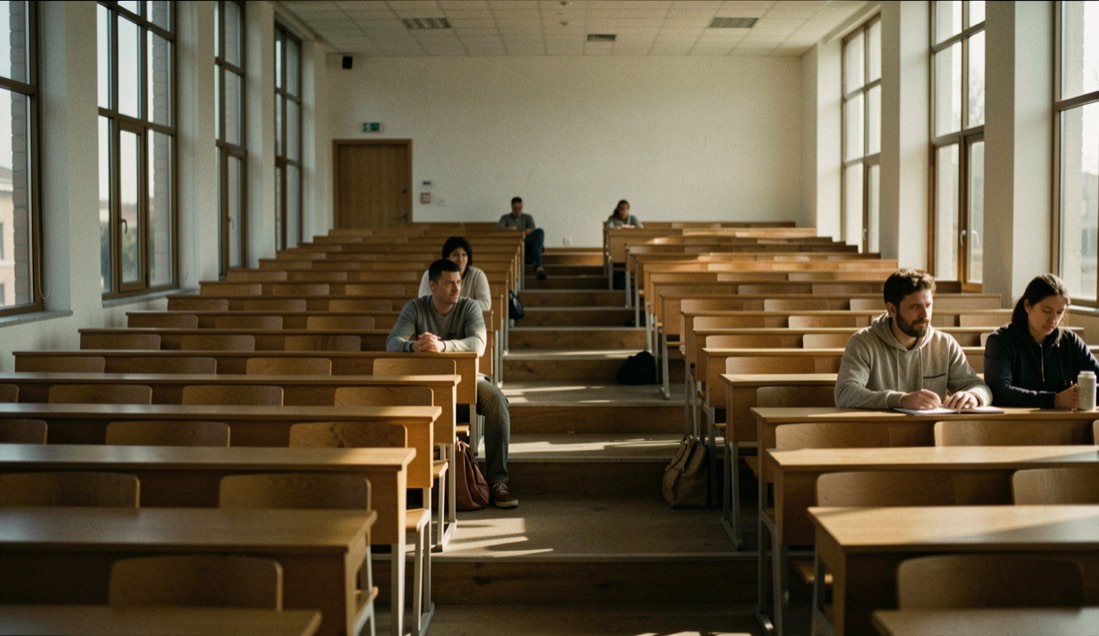
A nine o'clock session ten minutes before it starts, in the middle of the second term.
Move the evening, not the morning
The instinct is to attack the alarm: set it earlier, use a harder tone, put the phone across the room. That treats the symptom. The bedtime is what determines whether the morning is possible, and it is the end of the day that can actually be changed.
Work backwards. Nine o'clock in a room twenty minutes away means leaving by half past eight, which means waking at half past seven, which means being asleep by midnight for eight hours or half past midnight for seven. That is the whole calculation, and the useful output is a bedtime, written down, treated as a fixed commitment on the same grid as everything else in a revision timetable that holds after week two.
Move it gradually. A body clock shifts by roughly a quarter of an hour a day, so pulling a two in the morning habit back to midnight takes about a week of consistent effort. Attempting it in one night produces an hour of lying awake and a conclusion that the plan does not work.
The morning light is the strongest lever available and the cheapest. Getting bright light within half an hour of waking, ideally outdoors, anchors the clock more effectively than anything you do at night. Walking to the nine o'clock lecture is itself the treatment for being able to attend the nine o'clock lecture.
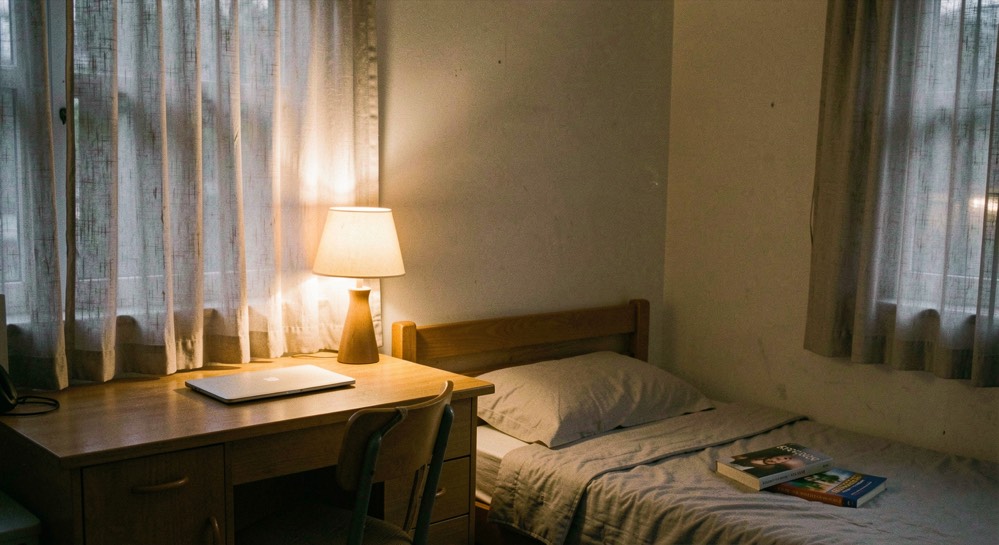
An evening room with the overhead light off and the laptop already closed.
The hour before, and the weekend problem
The last hour of the day decides how quickly the first part of the night goes. Bright overhead light, a screen at arm's length and an argument in a group chat all delay sleep onset; low light, a paper book and a room that is genuinely cool do the opposite. None of this is exotic and all of it is cumulative.
Caffeine deserves a specific mention because the timing is counterintuitive. Half of a mid afternoon coffee is still circulating at bedtime, so the four o'clock cup that felt harmless is part of why midnight is not working. Alcohol is the other common trap: it shortens the time to fall asleep and wrecks the second half of the night, which is why a late night out costs two days rather than one.
Then there is the weekend, which is where most carefully rebuilt schedules go. Two nights of going to bed at three undoes most of a week's adjustment, and Monday morning arrives with a body clock that thinks it is Saturday. Keeping the wake time within an hour or so of the weekday time, even after a late night, protects far more than it costs.
The timetable side of the question is what this page covers; the deeper case for the number itself, what the hours protect and how to defend them in exam weeks, is made in seven hours in term time.
Set the sleep window the way you set a lecture time:
- Work backwards from the earliest start of the week to a written bedtime.
- Shift it by about fifteen minutes a day, not in one attempt.
- Get outdoor light within half an hour of waking, every day it is available.
- Keep the weekend wake time within an hour of the weekday one.
Two limits, and neither is small. Shift work is the first: a job with late finishes makes a stable window genuinely difficult, and the honest answer there is to protect consistency rather than the hour itself, choosing shifts that repeat rather than rotate. The trade offs of paid hours during term are worked through in part time hours without wrecking the term.
The second is that persistent insomnia is a different problem from a drifting schedule, and none of the advice above addresses it. Lying awake for an hour every night for weeks, or waking at four and not returning to sleep, is worth taking to a doctor rather than solving with a darker curtain. Registering with a practice in the first fortnight, as set out in the first fortnight, hour by hour, is what makes that a short conversation rather than a project.