
A week block filled in pencil, with two empty squares kept free on purpose.
Building the timetable is the most enjoyable part of revision, which should be a warning. An hour spent with coloured pens producing a grid where every waking hour has a subject is an hour that feels like preparation and produces nothing except an object that will be abandoned in nine days.
Plans fail for the same three reasons every time: they assume a working day nobody has, they leave no room for the work being slower than expected, and they have no defined behaviour for a missed session. The third is the one that actually kills them, because a plan with no recovery rule turns one bad Tuesday into an abandoned system.
Start from the hours you really have
Write down the fixed commitments first: contact hours, the shifts you have already agreed, travel, the evening you always spend the same way. What is left is the raw material, and for most people it is a good deal less than they imagined.
Then cut it. Sustained focused study runs at about four to five hours a day, and that is on days without lectures. Anyone planning ten hour days across a fortnight is planning fiction, and the plan's collapse will be read as a personal failure rather than as an arithmetic error made three weeks earlier.
Work in blocks with ends. Fifty minutes on, ten off, with a longer break every third block, is a shape most people can hold. What matters more than the exact numbers is that a block has a defined end, because open ended sessions drift and the drift is invisible until the evening is gone.
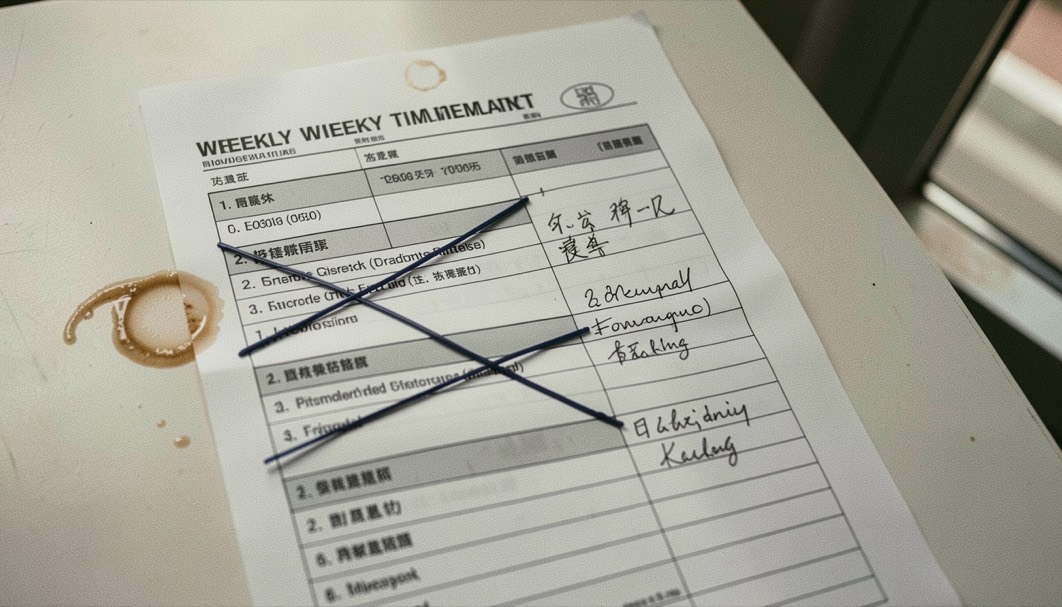
A plan in its second week, with three blocks crossed out and rewritten rather than replaced.
Schedule tasks, not subjects
"Revise chemistry, two hours" is not a plan, it is a mood. It cannot be finished, so it ends when you get tired, and it invites the passive rereading that fills any block with no defined output.
Write the block as a task with an end state. Not "history" but "write a plan for the 2023 question on wartime rationing and check it against the mark scheme". Not "statistics" but "twelve mixed problems from chapters four and six, marked". Then you know when the block is finished, and you know at the end of the week what was actually done.
Put the hard material where your attention is best. Most people have two or three genuinely sharp hours, and spending them on tidying notes while the difficult derivation waits for eleven at night is a scheduling error that no amount of discipline compensates for.
Build in the slack, then defend it
Leave one weekday evening and one weekend session completely empty every week. They are not free time. They are the catch up slots that absorb the block you missed on Tuesday because something ran late. A plan with slack survives a bad week; a plan without it converts one missed session into a backlog and then into abandonment.
Write the recovery rule down before you need it. A missed block is not moved and not doubled up. It goes into the next empty slot, and if two slots are already spoken for, it is dropped. Dropping a session deliberately is a decision. Letting three pile up silently is how plans die.
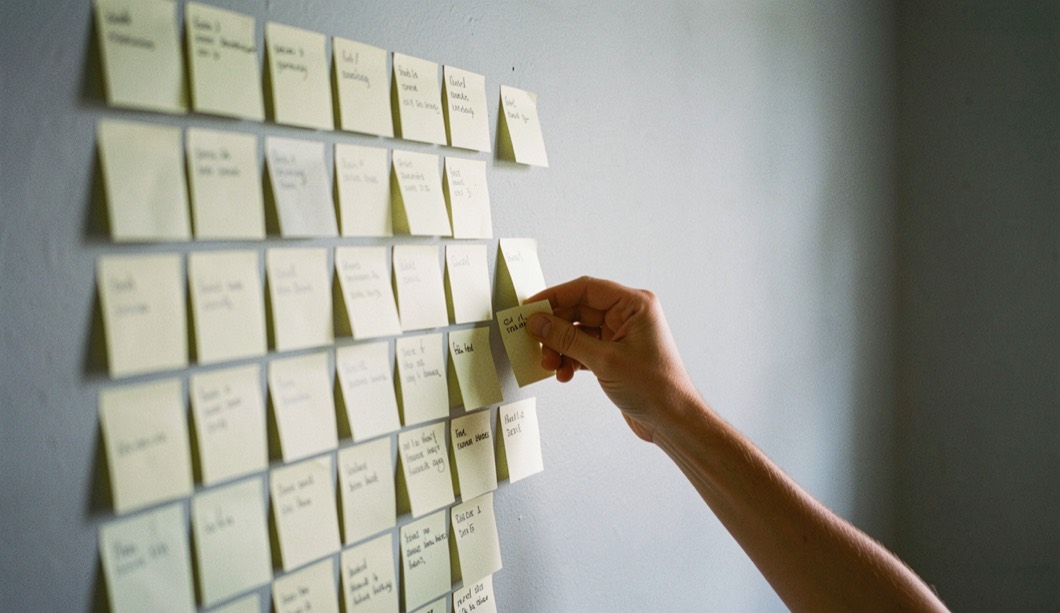
One note per task, moved rather than rewritten when a session is missed.
A timetable is fit to use when all of these are true:
- It is built from the hours left after fixed commitments, capped at four or five focused hours a day.
- Every block names a task with a finishable output, not a subject.
- There are two empty catch up slots a week, kept empty.
- The rule for a missed block is written on the plan itself.
Review it weekly, on paper
Fifteen minutes on Sunday, with the week's plan in front of you. Which blocks happened, which did not, and which took twice as long as estimated. The last of those three is the most valuable number you will collect, because estimation error is systematic and personal, and after three weeks you will know your own multiplier.
Adjust the next week from that evidence rather than from resolve. If problem sets consistently take ninety minutes and you keep booking sixty, book ninety. The plan is a measuring instrument as much as a commitment.
Two limits. A timetable schedules time and cannot schedule understanding, so a block that assumed a topic was straightforward will overrun when it is not, and no planning method prevents that. And in the final week the plan should thin out rather than tighten, for the reasons set out in the last three days before an exam.
Note also what belongs in the plan besides revision. The daily card pass from spaced repetition without an app takes twenty minutes and should be booked, not squeezed. Paid shifts belong on the same grid as everything else, which is the argument in part time hours without wrecking the term. And sleep is a fixed commitment, not the slack, as sleep and the nine in the morning lecture spells out.