
A corridor on move in day, before any of the doors have names on them.
The first two weeks arrive with a strange mixture of urgency and emptiness. There is a great deal of administration that feels critical and takes an afternoon, and a great deal of unstructured time that feels harmless and quietly decides how the year will run.
The useful way to think about the fortnight is that you are installing defaults. Where you work, when you get up, who you eat with, whether you go to the nine o'clock class in week two: none of these is decided consciously, and all of them are extremely hard to change in November.
Day one and day two: clear the administration
Do the boring items immediately, in one block, because they generate friction every day they remain undone. Register with the institution and collect the card that opens doors. Register with a local doctor, which people postpone until they are ill and it is the worst possible moment. Set up the local bank arrangement if you need one. Find out how the library actually works, including how long a loan runs and what a fine costs.
Two more that are usually forgotten. Check the tenancy paperwork and the inventory before anything is unpacked, because the deposit dispute in June is decided by what was recorded in September, and the detail of that is in deposits, bills and the tenancy. And write down the exact times and rooms of your teaching for the first fortnight, on paper, somewhere visible. Give the same first afternoon ten minutes for alarms, exits and keys; the ten minute safety check is the part nobody hands you.
Then find your places. One place to work in silence, one place to work with other people, and one place to be that is neither your room nor a bar. Walk to each of them once. Knowing where you are going at nine in the morning removes a decision that otherwise gets made in bed.
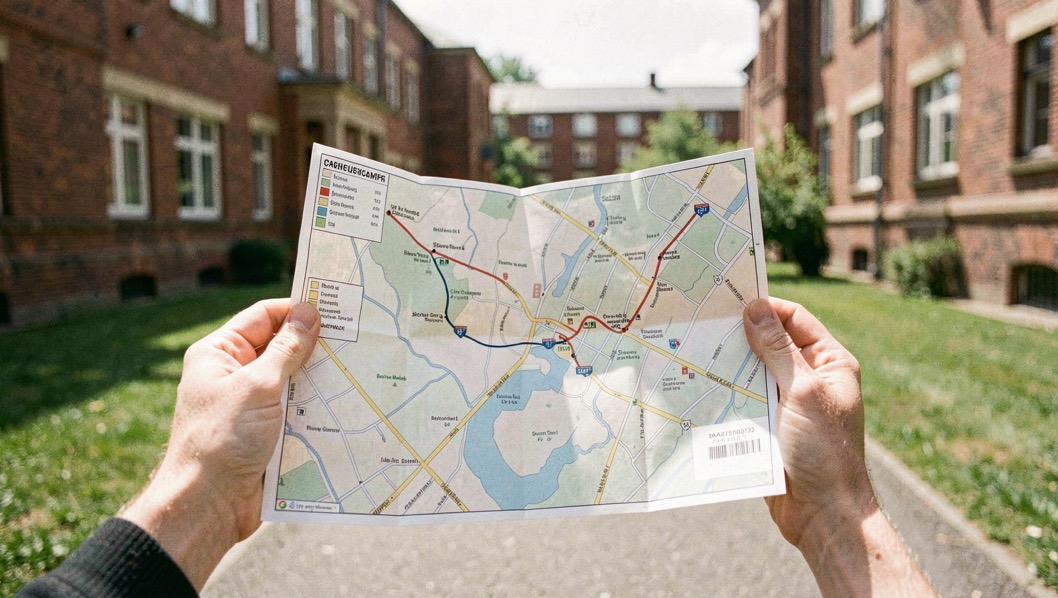
A route walked once before it has to be found in a hurry.
The first week: meeting people without exhausting yourself
The introductions week is loud, relentless and unrepresentative. Almost nobody meets their eventual close friends in it, and the people who seem to have assembled a whole social life by Thursday have usually assembled a group of acquaintances who will disperse by November.
What works better is repetition. Friendship is mostly a function of seeing the same people regularly in the same place, which is why the durable connections come from a course seminar, a shared kitchen, a weekly training session or a society that meets every Tuesday. The single highest value social act of the fortnight is going back a second time to something you attended once. The training sessions count double when they come with a season attached; what the season asks of your kit is worth reading before the first away fixture.
The kitchen deserves specific effort, because it is the one room you cannot avoid. Eating at the same hour as your flatmates for the first fortnight costs nothing and does more for the atmosphere of the flat than any conversation about the washing up rota. Have that conversation anyway, in week one, while everyone is still being polite. The same kitchen can run a slower project alongside the rota; a jar that ferments itself asks for a shelf and a label and feeds the flat for weeks.
It is entirely normal to find the first fortnight hard. A significant part of the noise is people performing confidence at each other, and the quiet week three, when timetables settle and the same faces reappear, is when most of the real thing starts.
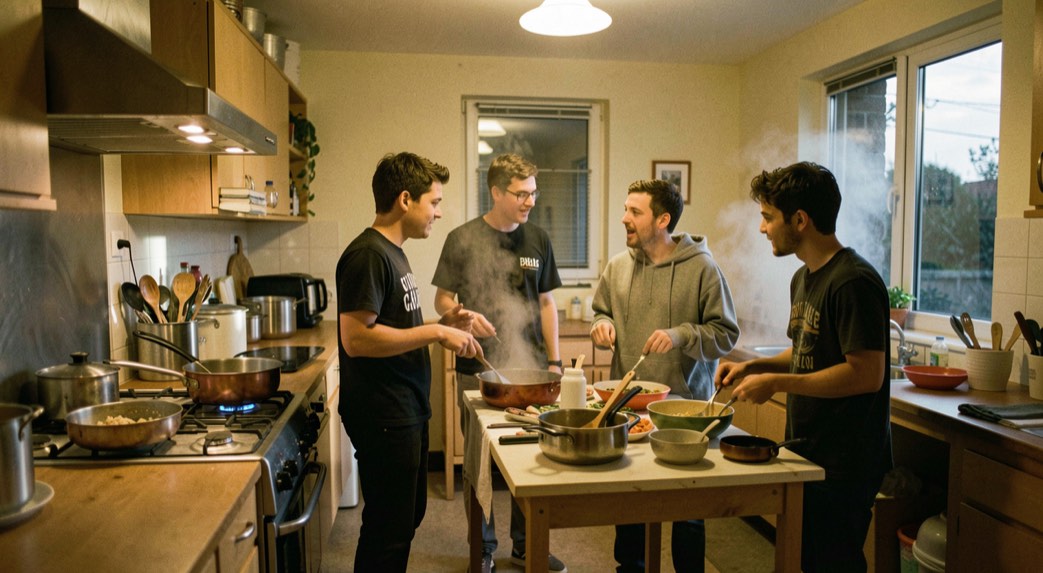
A shared kitchen at the hour when everyone happens to be cooking at once.
Week two: the habits that will still be there in March
Week two is when the timetable becomes real and the defaults set. Go to everything, including the sessions that turn out to be optional, because you cannot tell which those are yet and attendance is a habit rather than a decision. Missing one nine o'clock lecture in week two is how missing all of them starts.
Fix the sleep window now rather than in October. Term starts with a fortnight of late nights and then presents you with a timetable that assumes you are awake; moving a body clock back takes about a week of consistent mornings, and doing it in week two costs far less than doing it in week eight. The method is set out in sleep and the nine in the morning lecture.
Start the note system in the first real lecture rather than waiting until you have found the perfect one. Whatever you use in week two is what you will use all year, so make it the version described in the Cornell page, six months later rather than the version where you write everything down and hope.
Set the money baseline in the same week. The first instalment of any grant or loan arrives looking like more money than you have ever had, and it is a term's living costs. Building the sheet before the spending starts is the argument of a budget sheet that survives term one.
For the students whose course sends them further out, the questions to ask before you go apply the same fortnight habits to a much emptier map.
By the end of the second week, these should be true:
- Registration, doctor, library and tenancy inventory are done and not pending.
- You have been back a second time to at least one thing you enjoyed once.
- Your teaching times are written down and you have attended all of them.
- A sleep window and a first budget exist on paper, however rough.
The limit of any fortnight plan is that it assumes a standard arrival, and many are not. Commuting from home, arriving with a family, starting in January, or coming from another country with visa and banking steps attached all change the shape of these two weeks considerably. The administration list still applies and is more urgent. The advice about repetition applies more strongly, because a commuter who leaves immediately after teaching has to build the repeated contact deliberately rather than receiving it from a corridor.
The other limit is that none of this fixes homesickness, which is common, largely unrelated to how well the fortnight is going, and usually eases somewhere between week four and week eight. Keeping the structural things in place while it passes is the point, and the structure is what this page is about. If joining things is the part you are unsure about, the balance is worked through in joining a society without losing a term.