
A short conversation at an office door, which is where most reference requests are best started.
References are asked for late, by email, in a hurry, from someone who taught a module eighteen months ago to a room of two hundred people. The result is a letter confirming that you attended and received a particular grade, which is technically a reference and does nothing for the application.
The difference between that and a useful letter is entirely within your control, and most of it happens well before the request is sent.
Who can actually write one
The best referee is not the most senior person you have met. It is the person who has watched you do work and can describe it: a seminar tutor, a project supervisor, a laboratory demonstrator, the academic who marked your dissertation, a personal tutor who has met you several times.
A manager from a part time job is often a stronger referee than a lecturer for a non academic application, because they have seen you turn up, handle pressure and deal with people over months. Employers usually want one academic and one professional referee, and the professional one is frequently the more informative.
Whoever you choose, they need to be able to say something specific and positive. If you are not confident that a person can, they are not the right referee, and asking anyway produces a lukewarm letter that is worse than a neutral one from someone else.
This is a large part of the argument for being visible during the course: going to office hours with an actual question, contributing in seminars, doing a project properly. None of that is manipulation, it is simply how someone acquires anything to write about. It also tends to follow from the habits described in the first fortnight, hour by hour, where attendance stops being a decision.
How to ask, and how much notice to give
Ask early. Two to three weeks before a deadline is reasonable, and a week is tight. Academics have teaching, marking and their own deadlines, and a request arriving three days before a closing date will produce a rushed letter or a refusal.
Ask in person where you can, or by email if not, and ask whether they are able to write a strong reference rather than whether they will write one. The wording gives them a graceful way to decline, and a decline is a useful answer that saves you a weak letter.
Then send everything they need in one message. The deadline and how the reference is submitted. What you are applying for, with the advertisement or a link. Your current CV. Which modules or projects you did with them, in which year, with the grades. A short paragraph on why you are applying and which qualities the application is asking for. Any specific thing you would like mentioned, such as a project you did well or the way you handled a difficult group.
That package is the whole method. It takes twenty minutes to assemble and it converts a letter written from a vague memory into one written from evidence.
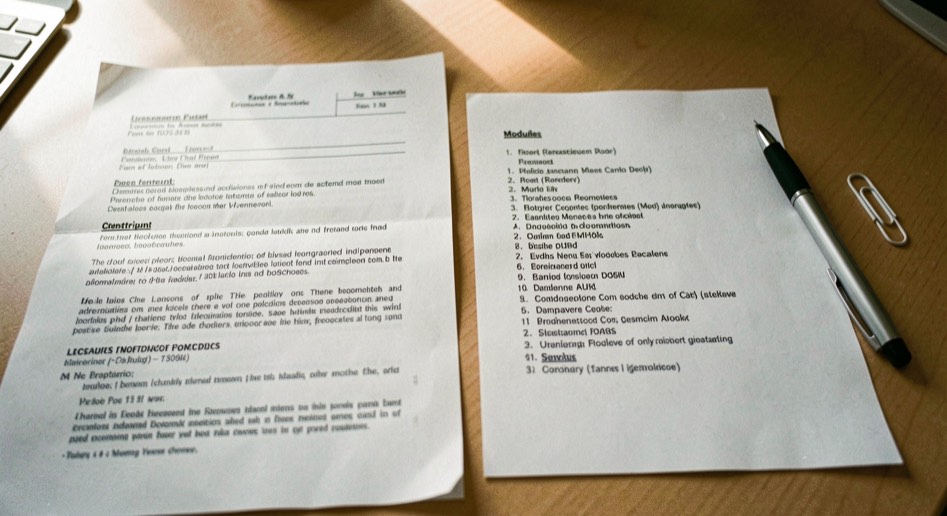
The material sent with a request: transcript, module list and the advertisement.
Managing several applications
Keep a list of who has agreed to write for you, for what, and by when. Applications multiply quickly and it is easy to lose track of which referee has been given which deadline, and to name someone on a form without having asked them, which is the one genuinely unforgivable step in this process.
Tell them each time. A referee who agreed in October to write for one placement has not agreed to write for eleven, and a brief message before each new application, with the details attached again, is both polite and practical.
Give reasonable notice of a cluster. Placement seasons produce a run of deadlines within a fortnight, and a referee told in advance that four are coming can plan for it, which is a very different experience from four separate urgent requests.
Then follow up once, briefly, a few days before the deadline if there is no confirmation. Once. And tell them the outcome, whichever way it goes, because the person who wrote for you has an interest and because you will very likely ask them again.
A deadline circled with the request date noted underneath it.
Every reference request should meet these conditions:
- The referee has seen your work and can describe it specifically.
- They were asked at least two weeks ahead, and asked whether they can write a strong letter.
- They received the advertisement, your CV, the modules you did with them and the deadline, in one message.
- Nobody is named on a form who has not agreed to it.
The limits are worth knowing so that a plain letter is not read as a bad sign. Many institutions and employers now use standard forms, and some organisations will only confirm dates and job titles as a matter of policy, so a short factual reference is often the format rather than a verdict. Some references are confidential and you will not see what was written, which is normal.
The other limit is that a reference rarely wins anything on its own. It confirms and it can quietly damage, but the interview and the application are what decide, which is why the effort belongs mostly in a first CV when the experience column is thin and in the preparation described in placement interviews: the questions that come back. Ask early, send the package, and then spend the remaining time on the parts of the application you write yourself.