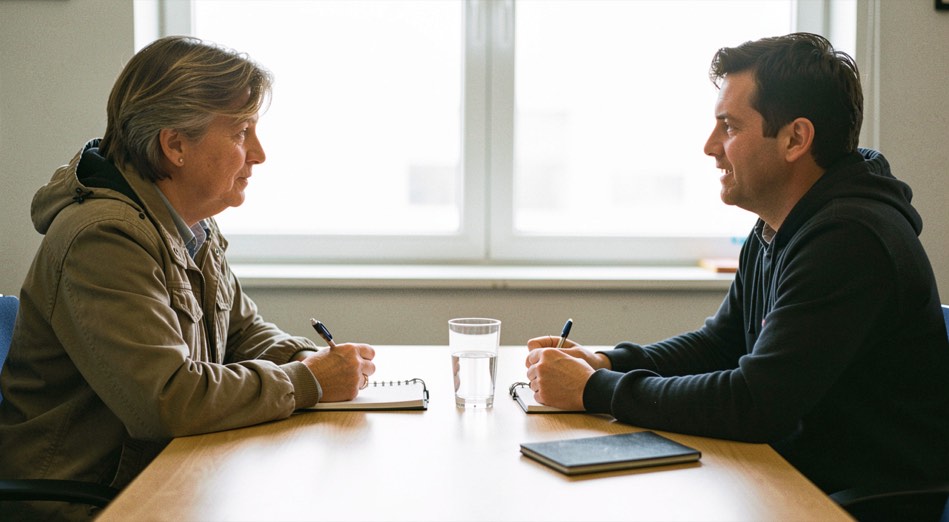
A short interview across a small table, which is what most placement interviews physically look like.
Placement interviews are more predictable than almost anything else in the application process. Whatever the sector, the interviewer needs to establish four things: that you can do the work, that you will keep doing it when it is dull or difficult, that you can work with other people, and that you have some reason for being in this particular room rather than any other.
Everything they ask is a route to one of those four, which is why preparing a small stock of real examples works far better than trying to anticipate the exact wording of questions.
The questions underneath the questions
"Tell me about yourself" is not an invitation to autobiography. It asks for a route: what you are studying, what pulled you towards this kind of work, what you have done that is relevant, and why you applied here. Two minutes, ending on the application.
"Why this company" is the question that most obviously separates candidates, and it is answered badly by praise. Anyone can say the organisation is a leader in its field. What works is a specific thing you know about them, connected to a specific thing about you: a product, a project, a way of working, a market they operate in, something a person who works there told you.
"Tell me about a time when" questions are asking for evidence of a behaviour, usually one of teamwork, conflict, pressure, failure or initiative. They cannot be answered in the abstract. They need an event with a date, a difficulty and an outcome.
"What is your greatest weakness" is asking whether you can assess your own work accurately. A disguised strength fails it. A real limitation with the specific thing you did about it passes it, and the doing is the whole answer.
"Where do you see yourself" is asking whether the placement fits a direction, not whether you have a plan for the next decade. A stated interest in a field, and what you want the year to teach you, is enough.

Four examples written out as notes the week before, one block each.
Building four examples instead of twenty answers
Choose four events from the last two years. A group project that went wrong, a piece of paid work with a difficult moment, something you organised, and something you learned quickly under pressure. Between them they will cover almost every behavioural question that gets asked.
Write each one out in four parts: the situation and why it mattered, what you specifically were responsible for, what you actually did, and what resulted. The third part is where most answers collapse into "we", and the interviewer needs to know which parts were yours. The fourth part is where a number belongs if one exists.
Keep them to about ninety seconds spoken. Practise saying them aloud rather than reading them, because the gap between a written answer and a spoken one is large and only shows up out loud. Then stop rehearsing the wording, since a memorised paragraph sounds memorised and cannot be redirected when the interviewer asks a follow up.
The material for these examples is easier to find if it was recorded when it happened, which is the same argument that makes a CV describable in a first CV when the experience column is thin. Expect every line of that page to be a legitimate question, and be ready to talk for five minutes about any of them.
A waiting area twenty minutes early, which is the right amount of early.
The parts people neglect
Prepare questions to ask, and make them about the work rather than about the perks. What does a placement student actually do in the first month, what does the team measure success by, what happened to last year's placement students. Having no questions reads as having no interest, and the answers are genuinely useful for deciding whether to accept.
Handle the practical items the day before, in the manner of any other scheduled performance: the route, the time, the format, whether it is a call or a room, who to ask for. The same principle as the packing list in the last three days before an exam applies here, because the failures are identical and equally avoidable.
For a remote interview, test the equipment beforehand, sit somewhere quiet with the light in front of you rather than behind, and look at the camera when answering rather than at the face on the screen. These are small things that change how an answer lands.
Afterwards, write down the questions you were asked while they are fresh. A short note after each interview builds, over a season of applications, an accurate picture of what this sector actually asks, which is worth more than any published list.
If the role involves showing rather than telling, the folder that backs the interview answers is handled in editing student work for applications.
Preparation for a placement interview comes down to four things:
- Four real examples, written in four parts each, practised aloud and not memorised.
- One specific, checkable reason for applying to this organisation.
- Questions about the work, prepared in advance.
- A note written the same day of what was actually asked.
Two limits. Technical interviews are a different exercise: a live coding task, a case study or a numerical test rewards practice on the skill itself, and no amount of behavioural preparation substitutes for it. Ask what the format will be when the invitation arrives, because most employers will tell you, and prepare accordingly.
The second is that interviews are decided partly on things you do not control, including who else applied and what the team needs this year. A rejection is frequently not a verdict on the preparation, which is a hard thing to believe after four of them. What the process reliably rewards is volume plus a note taken after each attempt, and the tutor who will speak for you when it works is best approached early, as set out in asking a tutor for a reference.