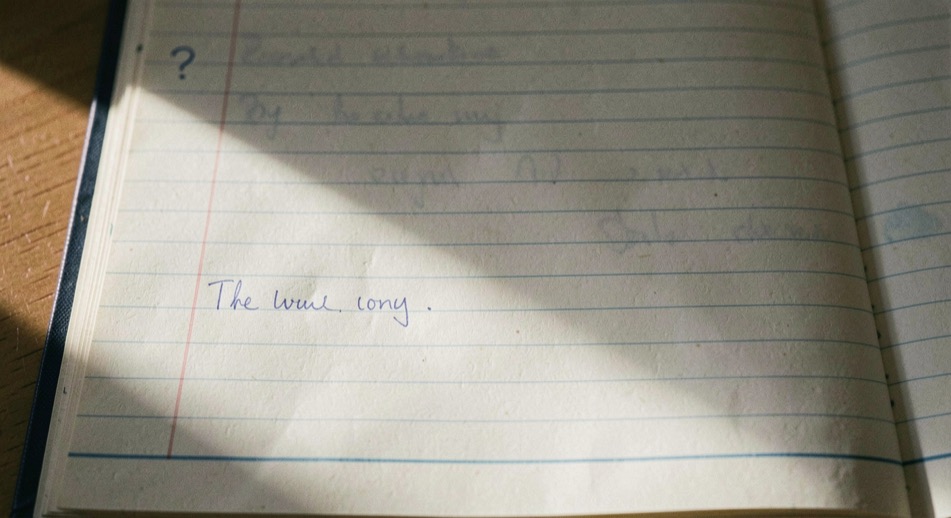
A close-up of a child's left hand resting on a school desk, holding a blue pencil on a lined exercise book, with a soft window light from the left and the rest of the classroom out of focus.
When does cursive start, and what comes before it?
The official French programmes describe a progression rather than a single starting point. In petite section (age 3), children handle tools, tear, crumple, and leave marks. In moyenne section (age 4), they draw lines, circles, and bridges, and they learn to sit and to hold a pencil with three fingers. In grande section (age 5), they write their name in cursive, often with a model, and they copy short words. CP is where cursive becomes the ordinary script for writing, with letters attached to each other and a regular slope.
The order of letters matters. Teachers usually start with the round letters (c, o, a, d), then the letters with a loop below the line (l, b, h, k), then the letters with a loop above (e, f, g, j), and finally the letters with a descending tail (p, q, y, z). The point is not aesthetic. It is motor: each family shares a direction of movement, so the hand learns one pattern before adding another.
Pen grip follows the same logic. The pencil rests on the middle finger, is held by the thumb and the index finger, and the hand rests on the edge of the palm. The wrist stays on the table, the forearm points towards the elbow, and the paper is tilted slightly to the left for a right-handed child, to the right for a left-handed one. A grip that is too tight, a wrist lifted off the table, or a body turned away from the sheet all slow the movement down before the letters are even formed.
Parents who want to follow this progression in detail, from the first marks in maternelle to the adjustments made in CE1, can read the French magazine Pleins et Déliés, which covers handwriting from the gesture itself to the classroom tools that support it. It is written for parents, teachers, and adults for whom writing remains costly.
Which signs in an exercise book suggest more than ordinary practice?
Ordinary practice looks uneven. A child who is learning writes a letter well on one line and badly on the next, presses too hard on a dictation, and produces a page that is readable but tiring. That is normal in CP and CE1, and it usually settles with time and regular short sessions.
Other signs point elsewhere. The first is persistence: after two or three years of regular teaching, the writing is still slow, still painful, or still illegible for the reader. The second is effort: the child produces a correct sentence but cannot hold it for a whole page, and the last lines collapse. The third is the body: the hand hurts, the child shakes it, the shoulder rises, the head comes down close to the paper, or the child complains of fatigue after ten minutes.
The exercise book itself gives clues. Letters of very different sizes on the same line, a slope that changes direction within a word, letters that are not attached although the class writes in cursive, a margin that is invaded, words that run over the line, or a page that is crossed out and rewritten several times all suggest that the movement is not yet automatic. So does a child who writes well in a copybook with lines and poorly on a blank sheet, or who reads well but writes far below that level.
None of these signs is a diagnosis on its own. They are reasons to look more closely, and to ask the teacher what happens in class, not only at home.
Who assesses handwriting when it stays costly?
In France, the first person to consult is usually the school doctor or the school nurse during the compulsory health check, and the teacher, who can describe what happens in class. If the difficulty persists, the family can ask for an assessment by a professional outside school. A psychomotor therapist (psychomotricien) works on the gesture, the posture, and the body's relationship to space. An occupational therapist (ergothérapeute) looks at the writing tool, the seating, and the way the child organises the page. A speech therapist (orthophoniste) is consulted when spelling or language is also involved. An ophthalmologist or an orthoptist may be needed if vision is suspected.
The assessment usually includes a standardised writing test, an observation of the grip and posture, and a look at several exercise books from different periods. The conclusion is not a label but a description: what the child can do, what costs energy, and what can be changed.
What support can a school put in place?
Support starts in the classroom, and it is often simple. A pencil with a wider barrel or a grip, a slanted desk, a sheet fixed to the table, a model placed on the right side for a right-handed child, shorter writing tasks, or the option to answer orally. Teachers can also reduce the amount of copying, dictate instead of writing on the board, or allow a keyboard for long texts while handwriting practice continues separately.
If the difficulty is recognised as a disorder, the school can set up a personalised support plan (PAP, plan d'accompagnement personnalisé), which lists the adjustments to be applied in class. For more significant needs, a project for schooling (PPS, projet personnalisé de scolarisation) may be drawn up, with a file submitted to the departmental office for disabled persons (MDPH). These procedures are administrative, and they take time, so it is useful to keep copies of assessments and exercise books.
The aim is not to make the child write like a model. It is to keep writing usable: readable enough for the teacher, fast enough for the lesson, and cheap enough for the child to have energy left for the rest of the day.
What practice at home actually helps
Short sessions beat long ones. Ten minutes a day, four or five times a week, is more effective than an hour on Sunday. The session should work on one thing at a time: the grip, then the slope, then the attachment between two letters. Copying a single line well is worth more than filling a page badly.
It helps to separate the moment of writing from the moment of thinking. A child who has to find the spelling, the idea, and the movement at the same time will produce worse writing than a child who copies a sentence already composed. Dictations of short, known sentences, or copying a text the child has just read, reduce that load.
Finally, the tool matters. A pencil that is too hard leaves a faint line and encourages pressure. A pencil that is too soft smudges and slows the hand. Paper with a clear ruling, a slight slope, and enough space between lines gives the eye a reference. These are small adjustments, but they change what the hand has to do.
Handwriting is taught, assessed, and adjusted. When it stays slow and costly, the answer is rarely more repetition of the same exercise. It is a closer look at the gesture, the tool, and the conditions in which the child writes.